

A phone charging at 15W can sometimes feel warmer than the same phone charging with a 45W adapter. That sounds backward, especially when we have spent years associating higher charging power with more heat.
But this is not necessarily a contradiction.
In a Reddit discussion on September 28, 2026, a Galaxy S25 user described noticing more heat with an older 15W charger than with a 45W Samsung charger supporting PPS. The user wondered whether the difference was related to charging efficiency or battery wear. It is an individual report, not proof that slower charging generally produces more heat, but it raises a useful engineering question.
Can a lower-wattage charger actually make a phone run hotter, and what should users check before blaming the charger?
From a charger manufacturer's perspective, the answer involves more than the wattage printed on the adapter. The phone's charging circuit, the charger's voltage profiles, protocol compatibility, battery condition, and the surrounding temperature all affect the result.
This article looks at the issue from the charging system's point of view and explains what charger brands and OEM buyers should consider when developing USB-C fast chargers.
Yes, it is possible in some circumstances, but a slower charger does not inherently make a phone hotter.
The temperature difference can depend on the charger's supported charging protocol, the voltage and current used, the phone's internal power-conversion efficiency, battery condition, background activity, and ambient temperature. A charger supporting a protocol such as PPS may allow a compatible phone to manage charging more efficiently under certain conditions.
However, you cannot determine the cause from the charger's wattage rating alone. The phone's actual charging power and temperature need to be observed under comparable conditions.
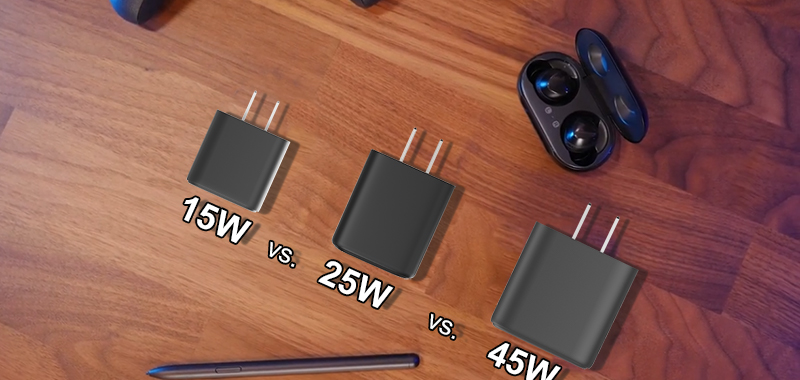
The confusion comes from treating charging power as if it directly determines temperature.
A 45W charger has a higher maximum output capability than a 15W charger. That does not mean it continuously delivers 45W to the phone, nor does it mean the phone will necessarily run hotter.
USB Power Delivery allows a compatible device to request an appropriate power level from a charger. The USB-IF describes this as a flexible power-delivery system in which devices can request the power they need. The actual power used depends on the negotiated charging conditions and the device's requirements. USB-IF's USB Power Delivery overview.
A phone may draw relatively high power when its battery is low, then reduce charging power as the battery fills or its temperature changes.
This means that comparing two adapters by their maximum wattage is not enough. You need to know how each adapter behaves with the same phone under similar conditions.
There is no single explanation. Several factors can produce this result.
Two chargers can provide different voltage and current combinations even when they are connected to the same phone.
An older charger may rely on conventional fixed-voltage behavior or a charging method that the phone supports but cannot use as efficiently as a newer, compatible fast-charging profile.
The phone's internal charging circuit then has to manage the power it receives. Depending on the implementation, some of the input power is converted into heat during voltage conversion and battery charging.
This does not mean that every older charger is inefficient. It means that the adapter's age and maximum wattage are not enough to determine how efficiently the complete charging system operates.
Programmable Power Supply (PPS) is an option within USB Power Delivery that allows compatible chargers and devices to negotiate adjustable voltage within supported ranges.
Instead of relying only on a small set of fixed voltage levels, the charging system can request voltage adjustments suited to its operating conditions.
For a compatible phone, this flexibility can help manage power conversion and charging behavior. Depending on the phone's design, it may reduce conversion losses or improve charging efficiency under particular conditions.
But PPS is not a universal temperature-reduction switch.
The phone must support PPS, the charger must implement compatible PPS profiles, and the charging system must actually use them. A charger marked PPS does not guarantee that every phone will charge faster or run cooler.
For a deeper explanation of the protocol differences, see our guide to PD 3.0 vs. PD 3.1 vs. PD 3.2 (AVS).
This is an easy factor to overlook.
If the phone is downloading updates, restoring data, running navigation, recording video, or maintaining a weak cellular connection, it is generating heat independently of the charging process.
That heat adds to the heat generated during battery charging.
Even two tests performed on the same phone can produce different results if one test runs background tasks while the other does not.
For a meaningful comparison, keep the phone's workload as similar as possible.
Battery temperature depends on more than the adapter.
An older battery, a phone case that restricts heat dissipation, a warm room, or direct sunlight can all affect the temperature observed during charging.
A phone that feels warm in a cool room may behave differently in a hot car or under a pillow.
This is why a single touch test is not a reliable way to compare chargers. It does not measure the battery temperature, the internal charging losses, or the actual power being delivered.
Not automatically.
A higher-wattage charger provides more available output power, but the connected phone decides how much power to draw within the supported charging arrangement.
A 45W adapter may charge a compatible phone at a higher rate than a 15W adapter. Whether the phone becomes warmer depends on how the device manages charging and how efficiently the overall system converts and stores energy.
There is another distinction worth making: the charger's temperature and the phone's temperature are different measurements.
A charger can become warm because its internal power-conversion components generate heat. Meanwhile, the phone can remain relatively cool—or become warmer—for reasons related to its own charging circuit, battery, and workload.
This is also why comparing products based only on how warm the adapter feels can lead to the wrong conclusion.
If a phone seems warmer with one charger than another, do not immediately assume that the hotter setup is defective.
Start by controlling the comparison.
Use the same phone and cable. Changing both the charger and cable at once makes it harder to identify the source of the difference.
Start with a similar battery level. Charging behavior changes as the battery fills. Comparing one test at 15% and another at 75% can be misleading.
Keep the environment consistent. Use the same room, remove direct sunlight from the equation, and avoid testing one charger on a soft surface and the other on an open desk.
Keep phone activity similar. Avoid comparing an idle phone with one running a demanding application.
Observe the actual charging behavior. Where suitable measurement equipment is available, record voltage, current, power, and temperature rather than relying only on the charger's advertised rating.
Allow enough time for the comparison. A quick observation immediately after plugging in may capture a temporary condition rather than the phone's behavior over a charging session.
For engineering work, the test setup should be documented so that the results can be reproduced.
For a charger manufacturer, the important lesson is that a wattage label is only one part of product performance.
When developing a 25W, 45W, or 65W USB-C charger, the engineering team needs to consider the intended devices, supported charging protocols, output profiles, conversion efficiency, thermal behavior, and protection design.
A charger can reach its rated output and still be poorly suited to a particular product if its protocol implementation or operating characteristics do not match the intended application.
A USB-C charger should be validated against the charging behavior it claims to support.
For PPS products, that includes checking the supported voltage range, current limits, negotiation behavior, and performance under relevant operating conditions.
The exact tests depend on the design and target specification. Simply confirming that the adapter powers on or displays a high wattage on a meter is not sufficient to establish complete compatibility.
A charger converts AC input power into regulated DC output power. Some energy is lost during conversion, primarily as heat.
A well-designed power stage, appropriate component selection, effective feedback control, and sound thermal design help manage those losses.
However, charger efficiency testing alone does not explain the temperature of the phone. The adapter and phone are separate power-conversion systems, and both can contribute to the observed result.
Our guide to charger efficiency testing explains how manufacturers assess conversion performance.
A charger designed primarily for smartphones does not necessarily face the same operating conditions as a 100W multi-port adapter powering a laptop and phone simultaneously.
Testing should reflect the actual product specification, including relevant output profiles, load conditions, temperature conditions, and multi-port behavior where applicable.
For a manufacturer, repeatable test conditions are essential. Otherwise, a product may appear to perform well in one sample test but deliver inconsistent results across production batches.
No. PPS is useful when the connected device supports it and can take advantage of its adjustable-voltage behavior.
A standard USB-C PD charger can still provide suitable charging performance for many devices. The best choice depends on the device's requirements and the charger profiles available.
Before buying a charger, check:
Whether the phone supports USB PD, PPS, or another required charging method
Whether the charger provides the corresponding output profiles
Whether the cable supports the intended charging power
Whether the charger has adequate thermal and electrical protection
Whether the product is from a supplier with credible specifications and testing
It is not necessary to buy the highest-wattage adapter available. It is more important to choose a charger that supports the device's requirements and performs reliably.
Some warmth during charging is normal. Charging involves electrical energy conversion, and the phone may also generate heat while its battery is being charged.
What matters is the degree of heat, whether it is persistent, and whether the phone shows other warning signs.
If the phone repeatedly becomes unusually hot, stops charging, displays a temperature warning, or develops an unusual smell or visible damage, stop using the setup and follow the device manufacturer's safety guidance. Do not continue testing a combination that appears unsafe.
If the issue occurs with one particular cable or adapter, stop using that component until its suitability can be confirmed.
A charger manufacturer should not dismiss every temperature complaint as normal, but neither should every warm phone be treated as evidence of a faulty charger. Proper diagnosis requires the charging conditions and behavior to be understood.
If the concern is heat coming from the adapter itself rather than the phone, see our guide to charger overheating and safety.
For brands sourcing fast chargers, the issue is a reminder to ask for more than the rated output.
Before approving a charger for a smartphone-focused product line, buyers should clarify:
Which USB PD and PPS profiles does the product support?
What are the maximum output voltage, current, and power ratings?
Has the product been tested with the intended device category?
How are output stability and thermal behavior evaluated?
What happens when the charger reaches its defined thermal or electrical protection limits?
For multi-port models, how is power allocated when another device is connected?
How does the factory control consistency between approved samples and mass production?
The answers should correspond to the actual product specification and documented test results.
For OEM and ODM projects, this information is particularly useful before finalizing the product configuration, packaging claims, and target-market requirements.
A phone that feels warmer with a 15W charger than with a 45W charger is not necessarily experiencing a problem, and it does not prove that slow charging produces more heat.
The difference may be related to charging profiles, PPS compatibility, conversion losses, battery condition, background activity, or the surrounding environment.
For consumers, the sensible approach is to compare chargers under similar conditions and choose a model compatible with the phone's requirements.
For charger manufacturers, the lesson is equally straightforward: a good fast charger is not defined by its maximum wattage alone. Protocol compatibility, stable output, efficiency, thermal behavior, protection, and consistent production all matter.
That is what turns a charger specification into a product that works reliably in everyday use.
It can happen under certain conditions, but it is not a general rule. Differences in charging profiles, conversion efficiency, phone activity, battery condition, and ambient temperature may affect the result.
Not necessarily. The phone does not continuously draw the charger's maximum rated power. Its actual charging behavior depends on the device, negotiated power, battery level, and operating conditions.
PPS can allow a compatible phone and charger to adjust voltage more flexibly. This may improve conversion efficiency under certain conditions, but it does not guarantee lower temperatures for every device.
An older charger may still be suitable if it is compatible, in good condition, and meets the device manufacturer's requirements. However, it may not support every fast-charging feature available with a newer charger.
Not necessarily. Some warmth is expected during power conversion. Excessive or unusual heat, charging interruptions, warnings, damage, or abnormal smells require more caution and may justify discontinuing use.
Yes, the cable is part of the charging system. Its electrical resistance, current capability, construction, and condition can affect power delivery and losses. A damaged or unsuitable cable should not be used.
Not for that reason alone. Choose a charger based on device compatibility, supported protocols, quality, and the charging performance you need. Higher wattage does not automatically mean lower temperature.
Depending on the product specification, testing can include supported PPS profiles, voltage and current behavior, protocol negotiation, output stability, thermal performance, protection behavior, and production consistency.
No. The charger and phone have separate power-conversion and thermal characteristics. A warm adapter does not automatically mean the phone will be warm, and vice versa.
Use the same phone and cable, start at a similar battery level, keep the environment and phone workload consistent, and record actual power and temperature where appropriate. Avoid drawing conclusions from a single quick observation.
