
Company News

PD3.0 vs PD3.1 vs PD3.2 (AVS)

Views : 16
Update time : 2026-05-22 18:31:57
PD3.0 vs PD3.1 vs PD3.2 (AVS) —— What Changed in USB-C Fast Charging From 100W to 240W?
USB-C charging technology has evolved rapidly over the past few years. What started as a simple fast-charging standard for smartphones has now become a universal power system capable of charging gaming laptops, monitors, power stations, and even industrial devices.
But many buyers, distributors, and even electronics brands are still confused about the differences between:
• USB PD 3.0
• USB PD 3.1
• USB PD 3.2
• PPS
• AVS
• EPR
Questions like these are becoming increasingly common:
• Is PD3.2 better than PD3.1?
• Does PD3.2 increase charging speed?
• What is AVS charging?
• Is PPS outdated?
• Do I need a new USB-C cable for PD3.2?
In this guide, ZX Power explains the real differences between USB PD 3.0, PD 3.1, and the newer PD 3.2 AVS ecosystem — including how these standards affect chargers, cables, laptops, smartphones, and future USB-C devices.


Why USB Power Delivery Keeps Evolving
Modern electronics demand far more power than older USB standards were designed to provide.
A few years ago:
• Smartphones typically charged below 20W
• Most USB devices only required 5V
• Laptop charging still relied heavily on DC barrel connectors
Today, USB-C is expected to power:
• Smartphones / TabletsUltrabooks / Gaming laptops / Portable monitors
• Drones / Mini PCs / Power tools / Portable power stations
As device power requirements increased, USB-IF continuously upgraded the USB Power Delivery specification.

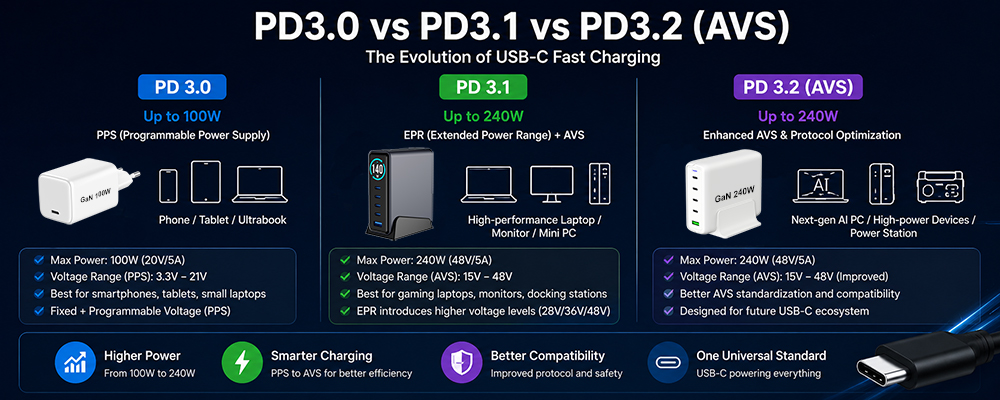
PD3.0 vs PD3.1 vs PD3.2 (AVS) What Changed in USB-C Fast Charging From 100W to 240W
What Is USB PD 3.0?
USB PD 3.0 became one of the most important milestones in USB-C charging history.
Released after PD2.0, it standardized intelligent voltage negotiation between chargers and devices while supporting up to 100W power delivery.


Key Features of PD 3.0
Maximum Power
USB PD 3.0 supports:
P = 20× 5A = 100W
This 100W ceiling became the mainstream standard for:
• USB-C laptop chargers
• GaN multi-port chargers
• Docking stations
• Monitor charging
• High-power power banks


PPS (Programmable Power Supply)
One of the biggest additions in PD3.0 was PPS technology.
PPS allows chargers to dynamically adjust voltage in very small increments instead of using only fixed voltages.
Traditional PD fixed voltages:
• 5V / 9V / 15V / 20V
PPS introduced flexible ranges such as:
• 3.3V–11V
• 3.3V–16V
• 3.3V–21V
This greatly improved charging efficiency for smartphones.


Why PPS Became Important
Smartphone batteries do not charge efficiently at fixed voltages all the time.
With PPS:
• Voltage can continuously adapt
• Heat generation is reduced
• Charging efficiency improves
• Battery stress decreases
This is why many Android flagship phones heavily rely on PPS fast charging.


Limitations of PD 3.0
Although PD3.0 was a major step forward, several limitations remained.
1. 100W Power Ceiling
Gaming laptops and workstation devices began exceeding 100W requirements.
Examples:
• High-end RTX laptops
• Mobile workstations
• Mini PCs
• Professional creator laptops
100W was no longer enough.


2. PPS Mainly Focused on Lower Voltage Devices
PPS worked very well for smartphones, but higher-voltage devices still needed better power management systems.
This led to the development of EPR and AVS.


What Is USB PD 3.1?
USB PD 3.1 was officially introduced in 2021 and represented one of the biggest upgrades in USB-C power history.
Its biggest breakthrough was increasing USB-C charging from 100W to 240W.


PD 3.1 Introduced EPR (Extended Power Range)
Before PD3.1: 20V×5A=100W
After PD3.1: 48V×5A=240W
USB PD 3.1 added new voltage levels:
• 28V / 36V / 48V

This new architecture became known as: 
EPR — Extended Power Range
EPR enabled USB-C to support:
• 140W laptop charging
• 180W gaming systems
• 240W USB-C power delivery
• Future high-performance devices


AVS Arrived With PD 3.1
PD3.1 also introduced:
AVS — Adjustable Voltage Supply
Unlike PPS, which mainly focused on lower-voltage flexible charging, AVS expanded adjustable voltage capability into higher power ranges.
AVS supports adjustable voltages such as:
• 15V–28V / 15V–36V / 15V–48V
This helps high-power devices operate more efficiently during charging.


Why AVS Matters for High-Power Charging
Higher voltage reduces current requirements.
For example: 240W at 48V

= 240W/48V = 5A

If the same 240W operated at lower voltage, cable current would increase dramatically, creating:
• More heat
• Higher energy loss
• Larger cable requirements
• Reduced efficiency
AVS helps optimize this process dynamically.


What Is USB PD 3.2?
This is where confusion starts for many consumers.
A large number of online articles incorrectly describe PD3.2 as a completely new power-generation standard.
That is not entirely accurate.


PD 3.2 Did NOT Increase Maximum Power
USB PD 3.2 still maintains the same 240W ceiling introduced by PD3.1.
Maximum power remains:
48V×5A=240W
So what changed?


The Real Purpose of PD 3.2
PD3.2 mainly focused on:
• Protocol refinement
• Naming consistency
• Better AVS standardization
• Improved mandatory AVS behavior
• More unified charger-device negotiation
Industry discussions also point out that PD3.2 strengthens AVS adoption in lower power ranges.


PD3.0 PPS vs PD3.1 AVS vs PD3.2 AVS
Feature PD 3.0 PPS PD 3.1 AVS PD 3.2 AVS
Max Power 100W 240W 240W
Voltage Range Up to 21V Up to 48V Up to 48V
Main Focus Smartphones High-power devices Broader AVS standardization
Adjustable Voltage Yes Yes Yes
EPR Support No Yes Yes
Typical Devices Phones/tablets Gaming laptops Next-gen USB-C ecosystem

Does PD 3.2 Charge Faster?
Not automatically.
Charging speed still depends on:
• Device charging architecture
• Battery design
• Thermal control
• Charger capability
• Cable capability
• Firmware optimization
A PD3.2 charger does not magically make every device charge faster.
However, PD3.2 improves compatibility and negotiation consistency for future USB-C ecosystems.


Do You Need Special Cables for PD 3.1 or PD 3.2?
For power above 100W, devices require: EPR USB-C Cables
These cables are specifically rated for:
• 240W
• 48V
• 5A
Standard 60W or 100W cables may not safely support full EPR charging.
Community discussions also clarify that cable capability matters more than “PD version labeling.”


Why Apple, Laptop Brands, and GaN Chargers Are Moving Toward AVS
The industry is gradually transitioning toward more intelligent voltage management systems.
Reasons include:
• Better thermal efficiency
• Reduced conversion losses
• Improved battery longevity
• Higher power scalability
• Better support for AI laptops and high-performance devices
AVS is expected to become increasingly common in future USB-C ecosystems.


How GaN Chargers Benefit From PD 3.1 and PD 3.2
Modern GaN chargers pair extremely well with EPR and AVS technologies because GaN semiconductors support:
• Higher switching frequency
• Lower heat loss
• Smaller internal transformers
• Higher efficiency under heavy loads

This allows compact chargers to safely deliver:
• 140W / 200W / 240W
through USB-C.


Which Devices Actually Benefit Most?
PD 3.0 Devices
Best suited for:
• Smartphones / Tablets / Small ultrabooks / Wireless accessories


PD 3.1 Devices
Ideal for:
• Gaming laptops
• Creator laptops
• Portable monitors
• High-performance USB-C docks


PD 3.2 Ecosystem
Most relevant for:
• Future AI PCs
• Advanced mobile devices
• Next-generation GaN chargers
• Smart multi-device charging systems


Future Trends of USB-C Power Delivery
USB-C is evolving beyond simple charging.
Future trends include:
• Unified charging ecosystems
• Higher efficiency protocols
• Intelligent thermal communication
• Dynamic power allocation
• AI-assisted charging optimization
• Higher density GaN architectures
• Full replacement of legacy DC barrel charging
The long-term goal is universal intelligent power delivery across all consumer electronics.


Final Thoughts
USB PD technology is evolving much faster than many consumers realize.
The progression looks like this:
• PD3.0 → PPS and mainstream 100W charging
• PD3.1 → EPR and 240W charging
• PD3.2 → More advanced AVS standardization and ecosystem refinement
For most everyday users, PD3.0 is still more than sufficient.
But for gaming laptops, AI PCs, high-power USB-C devices, and next-generation charging systems, PD3.1 and PD3.2 are becoming increasingly important.
As USB-C continues replacing proprietary charging systems, AVS and EPR will likely shape the future of universal fast charging.


About Zonsan
Zonsan Official Website↗
ZX Power is a professional USB-C fast charger manufacturer specializing in:
• GaN chargers
• PD/PPS chargers
• 140W–240W EPR chargers
• Multi-port desktop charging stations
• OEM & ODM charging solutions
• USB-C laptop chargers
• Smart charging technologies
With deep expertise in USB PD protocols, GaN power architecture, and high-efficiency charging systems, ZX Power provides advanced charging solutions for global B2B customers and electronics brands.


FAQ
Q1: What is the difference between PD3.0 and PD3.1?
USB PD3.0 supports up to 100W charging, while PD3.1 increases the maximum power to 240W through EPR (Extended Power Range). PD3.1 also introduces higher voltage levels such as 28V, 36V, and 48V for high-performance devices.

Q2: What is PD3.2?
PD3.2 is an updated USB Power Delivery specification focused on improving AVS (Adjustable Voltage Supply), protocol consistency, and charger-device communication. It does not increase the maximum charging power beyond 240W.

Q3: What is AVS in USB PD charging?
AVS (Adjustable Voltage Supply) is a charging technology introduced with USB PD3.1 that allows voltage adjustment across wider and higher power ranges. It improves charging efficiency, thermal management, and power delivery stability for laptops and high-power USB-C devices.

Q4: Is AVS better than PPS?
PPS is mainly optimized for smartphones and lower-voltage charging scenarios, while AVS is designed for higher-power devices such as gaming laptops, portable monitors, and advanced USB-C systems. Both technologies improve charging efficiency, but AVS supports higher voltage ranges.

Q5: Does PD3.2 charge faster than PD3.1?
Not necessarily. Charging speed depends on the charger, cable, device hardware, battery design, and thermal management system. PD3.2 mainly improves compatibility and AVS implementation rather than increasing charging wattage.

Q6: Can PD3.1 charge older PD3.0 devices?
Yes. USB Power Delivery standards are backward compatible. A PD3.1 charger can safely charge PD3.0 devices at supported power levels.

Q7: Do I need a special cable for 240W charging?
Yes. Charging above 100W requires a certified USB-C EPR cable rated for 240W and 5A current. Standard USB-C cables may not safely support full 240W charging.

Q8: What devices benefit most from PD3.1 and PD3.2?
Devices that benefit most include:
• Gaming laptops
• Creator laptops
• AI PCs
• Portable monitors
• High-power docking stations
• 140W–240W GaN chargers
• Future high-performance USB-C electronics

Q9: Is USB PD3.2 the future of USB-C charging?
PD3.2 and AVS technologies are expected to become increasingly important as USB-C expands into higher-power applications, including AI computing, gaming systems, and universal charging ecosystems.

 
Related News
Read More >>
New Product | 70W GaN Type-C Charger New Product | 70W GaN Type-C Charger
May .25.2026
The most popular fast charger, GaN 70W USB-C charger, support PD PPS PD3.2 AVS for laptops and iPhone 17 pro max, SFC3.0 for Samsung S26 Ultra and future models.
ZONSAN PD Charger Manufacturer ZONSAN PD Charger Manufacturer
May .16.2026
We ZONSAN are professional PD charger manufacturer over 17 years, with BSCI / KC / GS / ISO 9001 approval
Newsletter