
Industry News

Why Is There Such a Wide Price Range for Chargers?

Views : 14
Update time : 2026-06-05 10:52:38
What Really Separates a $5 Charger from a $50 Charger?
Walk into any electronics store or browse an online marketplace, and you'll notice something surprising:
A USB-C charger can cost $5, $15, $30, or even $80—yet many of them appear almost identical.
Some claim to offer:
• 20W charging
• 65W charging
+• 100W charging
• GaN technology
• USB PD fast charging
At first glance, it's easy to wonder:
Why is there such a massive price difference between chargers?
Are expensive chargers simply overpriced?
Are cheap chargers actually dangerous?
Does paying more automatically mean better quality?

The reality is more complicated than most consumers realize.
Inside a charger, dozens of engineering decisions affect performance, safety, efficiency, reliability, and manufacturing cost. Two chargers may look nearly identical from the outside while having completely different internal architectures.

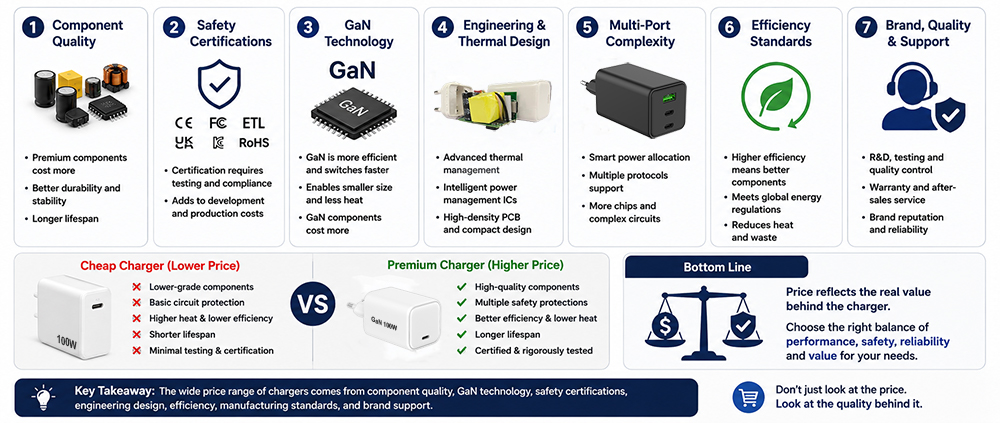
In this guide, ZX Power explains the key factors behind charger pricing and what buyers should pay attention to before making a decision.


The Biggest Misconception: "All Chargers Are Basically the Same"
This is perhaps the most common misunderstanding among consumers.
Many people compare chargers based on only three visible factors:
• Wattage
• Number of ports
• Appearance

For example:
Charger A Charger B
65W 65W
USB-C USB-C
Similar size Similar size
One costs $12.
The other costs $39.
Many buyers assume the cheaper option is the better deal.
But the real differences are hidden inside the charger.


Not All 65W Chargers Deliver the Same Performance
Power rating only tells part of the story.
A charger advertised as 65W may:
• Deliver 65W continuously
• Deliver 65W briefly, then throttle
• Produce more heat
• Generate less heat
• Have tighter voltage regulation
• Have poorer power stability
In engineering terms, two products can share the same wattage while performing very differently under real-world conditions.


Component Quality Makes a Huge Difference
One of the largest cost differences comes from internal components.
A charger contains:
• Power ICs
• MOSFETs or GaN transistors
• Transformers
• Capacitors
• Inductors
• Safety components
• PCB materials

Higher-quality components cost significantly more.
For example, premium capacitors are designed to withstand:
• Higher temperatures
• Longer operating hours
• Greater voltage stress
Cheaper capacitors may work perfectly when new but degrade faster over time.
This is one reason why some chargers last for years while others fail after months of use.


Safety Certifications Add Real Cost
Many consumers focus on charger price without considering certification costs.
Reputable manufacturers invest heavily in compliance testing.
Common certifications include:
• CE, RoHS, FCC, UKCA, CB, ETL, KC, KCC, EAC, and more.

Obtaining these certifications requires:
• Laboratory testing
• Product redesign
• Documentation
• Ongoing compliance audits
These costs are built into the final product price.

A charger that has genuinely passed certification testing typically costs more to manufacture than one that has not.


Why GaN Chargers Usually Cost More
Gallium Nitride (GaN) technology is one of the biggest innovations in charger design.
Compared with traditional silicon, GaN transistors offer:
• Faster switching speeds
• Higher efficiency
• Smaller magnetic components
• Better power density
This allows manufacturers to create compact chargers that deliver high power levels.

For example:
Technology  Typical Size
Traditional Silicon 100W Charger Large
Modern 100W GaN Charger Significantly Smaller
However, GaN components remain more expensive than many traditional silicon alternatives.
That additional cost is reflected in retail pricing.


Engineering and Thermal Design Matter
One interesting observation from online charger discussions is that consumers often judge products by appearance.
What they cannot see is thermal engineering.
A well-designed charger may include:
• Advanced heat dissipation structures
• Thermal monitoring sensors
• Intelligent power management
• High-density PCB layouts
• Optimized airflow paths
These features require engineering expertise, testing, and development time.
The result is a charger that runs cooler, lasts longer, and performs more consistently.


Multi-Port Chargers Are More Complex Than They Look
Many buyers assume adding more USB ports is inexpensive.
In reality, multi-port chargers require sophisticated power management.
Consider a 100W charger with:
• 2 USB-C ports
• 1 USB-A port

The charger must continuously determine:
• Which devices are connected
• How much power each device requests
• How power should be distributed

For example:
Scenario Output Allocation
One laptop connected 100W
Laptop + phone 65W + 30W
Three devices Dynamic distribution
This requires advanced controller chips and firmware, increasing production costs.

Why Some Cheap Chargers Can Offer Similar Specifications
This is where things become confusing.
Many low-cost chargers advertise specifications that appear similar to premium products.
Examples include:
• 65W
• GaN
• PD 3.0
• PPS support
Yet prices can be dramatically lower.

Why?

The answer often comes down to compromises.
Manufacturers may reduce costs through:
• Lower-grade capacitors
• Simpler thermal designs
• Fewer protection mechanisms
• Less rigorous testing
• Lower manufacturing standards
This does not automatically mean every inexpensive charger is bad.
However, lower prices usually reflect some form of cost reduction somewhere in the design.


Brand Reputation Also Affects Pricing
Part of the price difference comes from factors beyond hardware.
Established charger brands invest in:
Research and development
• Quality control
• Warranty support
• Customer service
• Firmware updates
• Product testing
These operational costs contribute to product pricing.
When customers pay for a well-known brand, they are often paying for reliability and support as much as the charger itself.


Why Industrial and OEM Chargers Cost More
For business buyers, charger pricing follows different rules.
OEM and ODM projects often include:
• Custom housings
• Private labeling
• Tooling costs
• Certification support
• Protocol customization
• Packaging design
• Regional compliance requirements
A charger developed specifically for a brand carries development expenses that generic products do not.


Efficiency Standards Influence Cost
Modern energy regulations are becoming stricter worldwide.
Regions such as:
• Europe / United Kingdom / South Korea / United States
continue raising efficiency requirements.

Higher efficiency often requires:
• Better components
• Improved power conversion
• More advanced circuit designs
Although this increases manufacturing costs, it reduces energy waste and heat generation.


Why Some Premium Chargers Are Worth the Extra Cost
The cheapest charger is not always the best value.
A higher-quality charger may provide:
• Better efficiency
• Lower operating temperatures
• Longer lifespan
• Greater safety margins
• Better compatibility
• More reliable fast charging
Over several years of use, the total cost difference often becomes relatively small compared with the benefits.


How to Evaluate a Charger Beyond Price
Instead of focusing only on cost, consider these factors:
Power Requirements
Choose a charger that matches your devices.
Examples:
• Smartphones: 20W–45W
• Tablets: 30W–65W
• Ultrabooks: 65W–100W
• Gaming laptops: 140W–240W


Certification
Look for recognized certifications appropriate for your market.

Fast Charging Protocols
Ensure compatibility with:
• USB PD, PPS, QC, PD 3.1, AVS
if required by your devices.


Build Quality
Pay attention to:
• Manufacturer reputation
• Warranty support
• Testing standards
• User reviews


The Future of Charger Pricing
As GaN technology becomes more widespread, prices will continue to decrease.
However, premium chargers will still differentiate themselves through:
• Higher efficiency
• Better thermal performance
• Advanced power management
• Smaller form factors
• Enhanced safety features
The market is likely to become more competitive, but engineering quality will remain a major factor in pricing.


Final Thoughts
The huge price range in chargers is not random.
A charger's price reflects a combination of:
• Component quality
• Safety certifications
• Engineering design
• Thermal management
• Fast charging technology
• Manufacturing standards
• Quality control
• Brand support
Two chargers may look nearly identical on a product page, yet be fundamentally different products internally.
When choosing a charger, the goal should not be finding the cheapest option or the most expensive option.
The goal should be finding the charger that delivers the right balance of performance, safety, reliability, and value for your specific needs.


About ZX Power
ZX Power is a professional OEM and ODM charger manufacturer specializing in:
• USB-C chargers
• GaN chargers
• PD 3.1 chargers
• PPS and AVS charging solutions
• Multi-port charging stations
• Laptop chargers
• Fast charging products from 20W to 240W
With extensive expertise in power electronics, safety compliance, and high-efficiency charging technologies, ZX Power provides customized charging solutions for global brands, distributors, retailers, and B2B customers.


FAQ
Q1: Why do some chargers cost five times more than others?
A: Price differences often come from component quality, safety certifications, thermal design, efficiency, and overall engineering rather than wattage alone.

Q2: Is a more expensive charger always better?
A: Not necessarily. However, higher-priced chargers often offer better reliability, safety features, certifications, and long-term durability.

Q3: Are cheap chargers unsafe?
A: Not all inexpensive chargers are unsafe, but extremely low-cost products may use lower-quality components or provide fewer protection mechanisms.

Q4: Why are GaN chargers more expensive?
A: GaN semiconductors are more advanced and allow smaller, more efficient charger designs. The technology and engineering involved generally increase manufacturing costs.

Q5: Does charger brand matter?
A: Brand reputation can indicate quality control, testing standards, warranty support, and long-term reliability.

Q6: What should I check before buying a charger?
A: Look at power output, charging protocols, certifications, compatibility, warranty support, and manufacturer credibility—not just price.


Learn more about USB GaN Charger
PD3.0 vs PD3.1 vs PD3.2 (AVS) ↗
Why Are Chargers Getting So Much Smaller? ↗
How USB-C PD Fast Charging Works ↗

 
Related News
Read More >>
New Product | 70W GaN Type-C Charger New Product | 70W GaN Type-C Charger
May .25.2026
The most popular fast charger, GaN 70W USB-C charger, support PD PPS PD3.2 AVS for laptops and iPhone 17 pro max, SFC3.0 for Samsung S26 Ultra and future models.
Newsletter