

The 65W charger has become one of the highest-demand fast charger categories in global B2B markets.
For brands, distributors, and sourcing managers, it offers the ideal balance between power, compatibility, size, and cost control.
This guide explains how 65W chargers are designed and manufactured, what OEM buyers should look for, and why sourcing directly from a charger factory or manufacturer is a strategic advantage in 2026.
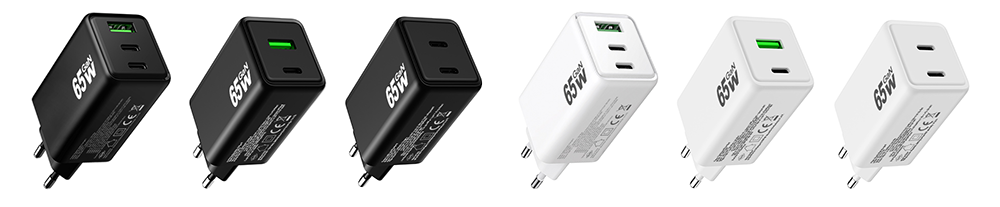
A 65W charger is a USB-C fast wall charger capable of delivering up to 65 watts of power, typically through USB Power Delivery (PD) and PPS protocols.
In OEM manufacturing, 65W chargers are widely used as universal charging solutions for smartphones, tablets, laptops, and multi-device ecosystems.
For B2B buyers, 65W chargers represent a core SKU with stable long-term demand across consumer electronics markets.
From a factory and supplier perspective, 65W chargers offer several structural advantages:
A single 65W charger supports:
Smartphones (iPhone, Samsung, Android)
Tablets and iPads
Ultrabooks and laptops
Accessories and IoT devices
This reduces SKU complexity for brands and distributors.
Compared with 100W chargers, 65W models:
Use fewer high-cost components
Generate less thermal stress
Achieve higher production yield
This makes them ideal for mass production and price-sensitive markets.
In professional charger manufacturing, a 65W charger is built through:
AC-DC power conversion using high-efficiency switching topology
Advanced PCB layout optimized for heat dissipation
PD / PPS protocol integration for dynamic power negotiation
Multi-layer safety protection design
Full compliance testing (CE, CB, FCC, UKCA, etc.)
Each step directly affects reliability, efficiency, and long-term safety.
Most premium OEM 65W chargers now adopt GaN (Gallium Nitride) components.
From a manufacturing standpoint, GaN enables:
Smaller transformer and PCB footprint
Higher switching frequency
Lower heat generation
Higher power density
This allows factories to deliver compact, high-performance chargers without sacrificing safety margins.
A compliant OEM 65W charger must include:
Over-voltage protection (OVP)
Over-current protection (OCP)
Over-temperature protection (OTP)
Short-circuit protection (SCP)
Flame-retardant housing materials
Additionally, most global buyers require:
CE / RoHS (Europe)
UKCA
FCC / ETL (North America)
KCC (South Korea)
CB certification for multi-region sales
Leading charger manufacturers offer full customization, including:
Output configuration (USB-C only or USB-C + USB-A)
Power allocation logic
PCB structure optimization
Housing material and surface finish
Logo, packaging, and branding
Plug types (EU, UK, US, KR)
This flexibility allows brands to differentiate without redesigning from scratch.

Compared to trading companies or off-the-shelf brands, sourcing from a charger factory provides:
Better cost control
Faster engineering response
Full traceability of components
Easier certification management
Long-term supply stability
For large-volume buyers, factory sourcing significantly reduces quality risk and after-sales issues.
Consumer electronics brands
Laptop and accessory bundles
Corporate procurement
E-commerce private labels
Telecom and operator channels
In many regions, the 65W charger is now considered a standard fast charger offering.
Yes. It balances compatibility, cost, and future-proofing better than 20W or 100W chargers.
Yes. Power delivery protocols ensure devices draw only what they need.
Not mandatory, but GaN significantly improves size, efficiency, and thermal performance.
CE, RoHS, CB, FCC, UKCA, and KCC depending on target regions.
Yes. Professional manufacturers offer internal structural and power design customization.
MOQ varies by factory, design complexity, and customization level.
Yes. Demand remains stable due to cross-device compatibility and USB-C adoption.
